Cluster model
home | Theory Group
Cluster modelhome | Theory Group |
|
The on-site electron-electron Coulomb repulsion obtained from Hartree-Fock or LDA atomic calculations is also of the order of 10eV.
|
For the solid, the state-of-the-art modified LDA and LSD calculations provide a quantitatively accurate description of the bandstructure, but fail in describing the multiplet splittings observed in core spectroscopies. |

|
 and X of a fcc lattice
bandstructure. Ni metal is represented in this model by 4 d
shells at the 4 lattice sites, filled with 38 or 37 electrons (i.e. 2 or 3
holes). Atomic electron-electron correlations are treated exactly, and the
bands are described at the two available points in terms of tight-binding
integrals dd
and X of a fcc lattice
bandstructure. Ni metal is represented in this model by 4 d
shells at the 4 lattice sites, filled with 38 or 37 electrons (i.e. 2 or 3
holes). Atomic electron-electron correlations are treated exactly, and the
bands are described at the two available points in terms of tight-binding
integrals dd , dd
, dd ,
dd
,
dd .
.
Menchero has applied recently this Ni4 cluster model to the dichroism in core photoemission spectroscopy (XPS) [Phys. Rev. Lett. 76, 3208 (1996)], with apparently good results, but...
|
We tried to
improve these properties changing the number of holes and tuning the
bandstructure, getting closer to experimental observation. The final
spectra are, however, in no better accord with experiment than what we
could get out of a much simpler impurity model à la
Anderson.
In the figure at the right, the lower part shows the isotropic and circular dichroic L2,3 x-ray absorption spectra (XAS) and the upper part gives the sum and the difference of the minority (up) and majority (down) 2p XPS spectra, in the same geometry as in the work by Menchero. Calculations are done for the Ni4 cluster with two X5 (dotted) and three X2 (solid) holes. | 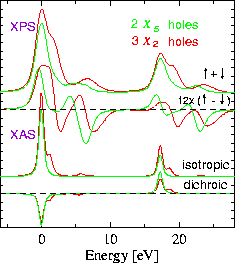
|
Those interested may read more in Manini, van Veenendaal, and Altarelli, Phys. Rev. Lett. 79, 2594 (1997).
| created: 19 July 1999 | last modified: 8 Jan 2026 by Nicola Manini |