Statistical Mechanics
Revised lecture notes,
for exercises classes first delivered on 19.12.2001 and 18.01.2002.
Equilibrium statistical mechanics is the basic ingredient to compute
thermodynamic properties of macroscopic systems based on the knowledge of
their microscopic dynamics.
The equilibrium probability distribution of different microstates in
any system at thermal equilibrium is determined uniquely by the
energy of these states, in an extremely simple way: at a given
temperature T, the probability P(E) of a given state of energy E is
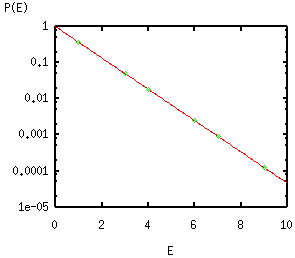
proportional to exp[-E/(kBT)].
Boltzmann,
the discoverer (inventor?) of this statistical distribution, leaves his
name to the constant
kB=1.38064852×10⁻²³ J/K, which is
basically the conversion factor between temperature and energy.
The quantity β = 1/(kBT) provides the angular coefficient
-β of the straight line representing Boltzmann's equilibrium
probability distribution in a lin-log plot.
The Boltzmann probability distribution is normalized to unity by dividing
each exp(-En/kBT) factor by the sum
Z=∑n
exp[-En/(kBT)]
extended to all the states (labeled by n) of the system.
Of course degeneracy has to be properly accounted for!
For example, for three states, one at energy A, and two at the same energy
B, this normalization sum equals: Z=exp(-βA)+2×exp(-βB).
This normalization factor Z is called the partition function.
Z acquires a central role in statistical physics, because all thermodynamic
functions can be derived from Z.
This basic idea finds applications in all problems of equilibrium
statistical mechanics.
For an arbitrary system, one is supposed to carry out the complete
calculation of the whole spectrum, and then use it to get the partition
function, and eventually all the thermodynamic averages.
In practice this project can be carried out analytically on fairly
small/simple problems, such as, e.g., two or three coupled spins.
A lot can be done also for the wide category of non-interacting
systems.
A good example of such kind of system is the
electromagnetic fields at equilibrium in a
cavity: this is likely the only properly non-interacting system in
physics: its exact thermodynamic properties can be computed with the
techniques of statistical mechanics.
Other examples include "isolated" spin systems, or internal excitations of
isolated atoms, or
isolated molecules. Here the
"isolation" property is an approximation. In highly rarefied systems, this
approximation is usually quite good.
For all these non-interacting systems, the Hamiltonian is the sum of
several (often identical) Hamiltonians, one for each isolated quantum
system (IQS).
The Hamiltonians really are the same for the rotation of molecules or the
spin states of atoms in a uniform magnetic field. Instead, when the normal
modes of the electromagnetic field are considered, they are all quantum
harmonic oscillators but with generally different frequencies.
Each IQS reaches equilibrium separately, independently of all other IQSs:
its states are occupied according to the Boltzmann probability distribution
P(E) governed exclusively by the "single-IQS" energy E.
When the IQSs are all the same, as in the case of a gas of equal atoms or
molecules, this implies that the average number of IQSs (also
called the "population") in a given quantum state n is the total
number N of IQSs multiplied by the probability of that state:
N×P(En).
Ideal fermion and boson systems
Other popular non-interacting systems are collections of identical
fermions or bosons. They are relevant to existing physical systems to the
extent that their particle-particle interactions can be neglected.
Boltzmann (grancanonical) statistics applied to the total energy
of a set of non-interacting fermions
(governed by Pauli's antisymmetrization requirement) gives a
single-particle probability distribution, the Fermi-Dirac distribution,
which turns out different from the one occurring without the
antisymmetrization requirement.
Similarly, the single-particle Bose-Einstein statistics derived from the
Boltzmann distribution of total energies of a set of bosons is also quite
different from the way it would be without the symmetrization requirement.
Note:
the justification of Bose-Einstein statistics given in Sect. 11-2 of Eisberg-Resnick
Quantum Physics
is incorrect.
In particular, the comparison of Eq. (11-1) (wrong, unnormalized) with
Eq. (11-2) (OK) is unfair.
Consequently, the enhancement factors n! of (11-3) and previous formulas
are pure fantasy, and the conclusion
if there are already n bosons in a quantum state, the probability of
one more joining them is larger by an enhancement factor of (1+n) than it
would be if there where no quantum mechanical indistinguishableness
requirements
is plain wrong.
An extra boson joins the quantum states available with a given probability
which only depends on the overlap of its initial state with the Hamiltonian
eigenstates available (and is normalized so that the sum over all the
states available is one). It does not care of the possible presence of
other bosons (as long as they are not interacting of course!). If it did,
the probability could not be normalized to unity.
Sadly, also "The Feynman" Lectures in Physics Vol. III Chap. 4 falls
in this same pitfall.
Exercises on spin systems
-
Compute the average energy U(T) and magnetization M(T), the zero-field
susceptibility per unit volume
χ(T) and
molar
χmol(T),
and the molar specific heat at fixed field for a gas of non-interacting
spin-½ particles of magnetic moment gµB and (low)
density N/V.
RESULT:
χ(T) = (N/V)
(gµB)²
β/4,
χmol(T)
= NA (gµB)²
β/4,
where NA is the number of particles in a mole NA=6.022×10²³ mol-1
-
Same as previous, for a gas of spin-1 particles.
RESULT:
Same
χ's as
previous, replacing 1/4 with 2/3
-
Same as previous, for a gas of particles where there is no quantization of
the angular momentum ("infinite spin", the classical limit), and the
magnetic moment is µ.
RESULT:
χ(T)=µ²(N/V)β/3
Note:
This same calculation can be carried out for a gas of dipolar molecules of
moment p0, in a uniform electric field E.
-
The Heisenberg model, appropriate for interacting localized spins,
can be written
HHeis = - J ∑<i,j>
Si·Sj
- b ∑i Szi
Here:
Si is the spin operator divided by ℏ for site i;
<i,j> indicates nearest-neighbor sites;
J is the nearest-neighbor exchange energy
(assume J>0, ferromagnetic exchange);
and b is the energy of coupling to an external magnetic field B,
assumed uniform and directed along the positive z direction:
b=gµBBz.
-
List all the quantum states where this model is defined on the basis where
the Szi operators are diagonal, for a lattice of N=2
sites.
-
For the case S=½, diagonalize HHeis on the basis of
previous point, i.e. list all eigenstates and eigenenergies. Use symmetry
considerations. Consider first the case b=0.
RESULT:
E1=-J/4+b,
E2=-J/4,
E3=-J/4-b, and
E4=3J/4.
-
For S=½ write down the exact partition function for N=2 and the
average spin z-component at site 1 [Sz1] as a
function of temperature and b. Show that [Sz1]
equals [Sz2] (of course!).
RESULT:
[Sz1] =
sinh(β b) / [1 + exp(-β J) + 2 cosh(β b)]
-
Try to repeat the above points for N=3 sites where each site is nearest
neighbor of the two others (3 spins on an equilateral triangle).
-
Describe the ground state for a large number N of sites, b=0, J>0, no
disconnected block of spins. Show in particular that its degeneracy is 2 N
S + 1, where S is the spin at each site (e.g. S=½, but not
necessarily). Discuss this degeneracy in terms of the symmetry of the
original model.
-
For the case of large N (hard to treat exactly: explain why!), build a
mean-field approximate theory. Replace the Sj
operator with its average value (and assume it is oriented along z, like
the external field). Assume further that all sites are equivalent and call
m=[Szj] (obviously -½<m<½,
but at this stage m is still an unknown quantity).
Rewrite the approximate Hamiltonian as:
HMF = - (m J nnn/2 + b) ∑i Szi ,
where nnn is the number of nearest neighbor sites to any given site i, and
the factor 1/2 avoids double counting the J interactions.
This mean-field Hamiltonian describes a set of uncorrelated spins in the
effective field created by the actual external field plus the average
effect of the neighboring atoms.
Depending on the spin of the original model, this mean field approximation
allows us to describe the Heisenberg model as a set of IQSs, whose
thermodynamics has been studied in previous problems 1, 2 or 3.
Consider e.g. the case S=½: apply the results for the magnetization
of exercise 1 and write down the self-consistent MF equation for
m=[Szi].
RESULT:
m = ½ tanh[½β(½ nnn J m + b)]
-
Study graphically the case b=0, and discover a critical temperature
Tc=nnn J/(8 kB) .
Show that the MF theory of the previous
point describes a nonmagnetic state (m=0) for T > Tc,
and a spontaneously-magnetized state (m≠0) for T < Tc.
Verify that the nonmagnetic state becomes an unstable solution of the
self-consistent equation for T < Tc.
Verify that for T→0, m→±½.
By expanding the tanh to third order in the self-consistent MF equation,
show that when T→Tc from the magnetized state, m→0, with a
temperature dependence of the type (Tc-T)x.
Determine the exponent x.
Discuss the transition at Tc in terms of properties of magnetic
materials.
RESULT:
x = ½
-
Study the case b>0: show that there exists a single stable solution
m(b)>0 for all temperatures.
Verify by taking a small b that m(b)≥m(0) for all temperatures.
-
By expanding the self-consistent MF equation, compute the magnetic
susceptibility ∂M/∂B(B=0) of the T>Tc
state, thus demonstrating the expected paramagnetic high-temperature
behavior.
RESULT:
χ(T)=g²µB²(N/V)
/ (4kBT - nnn J/2)
-
Explain why the calculation of the susceptibility in the low-temperature
phase does not make sense.
-
Redo the same treatment as above for the S=1 case.
-
The Heisenberg model with J<0 describes some properties of a large class of
antiferromagnetic compounds, such as NiO, for example.
Assume that the lattice is bipartite (it can be divided into two
sublattices, such that all the nearest neighbors of any site belong to the
other sublattice).
-
For J<0 revise the results of the N=2-sites case (points a-c of the previous
exercise).
-
Assume that the magnetization is uniform in each of the two sublattices,
but not necessarily equal.
Assume further that both magnetizations [Ss.l. 1 or 2]
are directed along z (this assumption is much less reasonable than in the
ferromagnetic case, and indeed, if one allows for canted states, (s)he
will find that they are lower in energy than the ones considered
here), and call them m1=[Sz1];,
m2=[Sz2] (sites 1 and 2 are assumed
to belong so sublattices 1 and 2 respectively).
Make the same mean-field approximation of the ferro case, separate
symmetrically the interactions for the spins at sublattices 1 and 2, and
show that the mean-field Hamiltonian can be rewritten as
HMF = (m2 |J| nnn/2 - b)
∑i in s.l. 1 Szi +
(m1 |J| nnn/2 - b)
∑i in s.l. 2 Szi
where again the factor 1/2 avoids double counting the |J|=-J interactions.
-
In analogy to the previous exercise, write down the self-consistent MF
equations for m1 and m2, for the case S=½.
RESULT:
m1 = ½ tanh[½
β
(b -½ nnn J m2)]
m2 = ½ tanh[½
β
(b -½ nnn J m1)]
-
Study the b=0 case: combine the MF equations into a single equation for,
say m1, and study it graphically.
Find a transition between a high-temperature nonmagnetic state and a
low-temperature antiferromagnetically-ordered state with
m2=-m1, at the temperature
TN=nnn |J|/(8 kB).
Verify that for T→0, m1→±½.
-
Study the b>0 case: show that now m2≠-m1.
Conclude that the total magnetization (proportional to
(m1+m2)/2) is positive all nonzero temperatures.
-
By expanding the self-consistent MF equations, compute the magnetic
susceptibility ∂M/∂B(B=0) of the T>Tc
state, thus demonstrating the expected paramagnetic high-temperature
behavior.
-
Explain the technical difficulty of doing the calculation of the
susceptibility in the low-temperature phase (which is paramagnetic anyway).
-
Redo the same treatment as above for the S=1 case.
More exercises of application of the Boltzmann equilibrium distribution to
IQSs are collected in the page about
molecules.
Exercises on quantum systems in equilibrium with electromagnetic
fields
In the following exercises, we shall assume to have a collection of
identical (distinguishable) IQSs, such as atoms, molecules, spins...
We shall indicate with R1→2 the rate of transition (the
probability of transition per second) of one of these systems from
state 1 to 2. The average total rate of transition will be
N1×R1→2, if N1 is the number of
systems initially in state 1. At thermodynamic equilibrium, one shall have
N1R1→2=N2R2→1.
In an excitation transition (E2>E1), clearly
R1→2 is proportional to the density of electromagnetic
energy per unit volume and per unit energy spectral interval
ρ(ε),
at the transition energy ε=(E2-E1)/h
in the region where these systems are placed.
Therefore R1→2 = B12 ρ(ε).
In a decay transition the spontaneous and stimulated emission rates add up
as follows:
R2→1 = A21 + B21ρ(ε).
Both these relations do not require thermodynamic
equilibrium to hold.
At thermodynamic equilibrium, however, one can take
the appropriate equilibrium distribution
u(ε,T) = π-2 c-3 ℏ-3
ε3/[exp(βε) - 1] for the radiant
energy density ρ(ε).
-
Consider atomic H gas in in thermodynamic equilibrium with radiation.
Determine:
-
The ratio between the probabilities of spontaneous and stimulated emission
at T=300K for the radiation produced by the decay of the 2p levels.
-
The temperature at which these probabilities become equal.
RESULT:
A21 / [B21 u(ε,T)]=
exp[ε / (kBT)] -1 = 2.6×10171,
Tequal = ε / (kB ln 2) = 170837 K.
-
Assume that approximately 10% of the mass of the Sun
(2×1030 kg) consists of gaseous H in its 1s or 2p
states.
Imagine that this gas is held all at the temperature T=6000 K.
How many atoms are spontaneously decaying and how many are decaying via
stimulated emission in a second?
RESULT:
Determine N1s and N2p by Boltzmann statistics.
Use the rate of spontaneous-emission computed in the exercise on the atomic-H bulb
A2p-1s=6.2649×10⁸ s-1
to evaluate the spontaneous emission total rate
N2p A2p-1s =
6.08×1056 s-1 and the result of previous
exercise to get
N2p B2p-1s
ρ(ε)=1.632×1048 s-1.
-
An oven (T=1200°C) contains Na vapor in equilibrium with the thermal
radiation. Compute the ratio between the stimulated and spontaneous
emission rates for the 3p decay. The associated wavelengths are 589,0 and
589,6 nm.
Compute also the temperatures at which these probabilities become equal.
A paradox
Take an extremely diluted ensemble of H atoms, so that it is safe to
neglect all interactions among atoms (IQS approximation).
Assume this gas has reached thermal equilibrium at a temperature T>0 of
your choice.
Neglect for simplicity all fine and hyperfine structure for the electronic
excitation spectrum: you have levels at energies -1Ry/n².
You may even ignore the (l, ml, ms) degeneracy 2
n² of all these bound states (it only makes things worse).
Compute the probability to find a given atom in its ground state n=1
(or equivalently the fraction of atoms in the ground state).
Standard Boltzmann statistics has:
P(n=1) = exp[1Ry/(kBT)] / Z
We need Z here.
We easily get a simple lower-bond estimate for Z by approximating all
states as if they were at 0 energy:
Z
=
∑n=0∞ ∑l=0n-1 ∑ml=-ll ∑ms=-½½
exp[- (-1 Ry/n²) / (kBT)]
=
∑n=0∞ 2 n² exp[1Ry / (n² kBT)]
>
∑n=0∞ 2 n² exp[0/(kBT)]
=
∑n=0∞ 2 n²
>
∑n=0∞ 1
=
∞
(this an obviously divergent series!).
You see here that including the growing degeneracy of the bond states only
makes things worse (i.e. infinity blow up even faster)!
Including the E>0 continuum states would also makes Z even bigger.
In conclusion:
P(n=1) = exp[1Ry/(kBT)] / ∞ = 0 !!!!!!!
This is very surprising, as at low enough temperature one would
expect, on the contrary, that most H atoms should be in their ground
state...
How do you solve this paradox?